

If you’ve lost your home, or you’re about to, the council may tell you you’re getting “emergency accommodation” or “temporary accommodation”. It’s easy to mix them up. They’re closely linked, but they’re not quite the same.
In this blog, we’ll cover what each one means in Scotland, how long you might stay, and what your rights are.
If you need somewhere to stay tonight, the numbers are just below.
The short answer
In Scotland, emergency accommodation is the first place a council will give you to stay while it looks into your situation. This is usually offered on the day you ask for help.
Temporary accommodation is where you live after that, until you’re offered a settled home. That can take months.
Both come from the same legal duty, and a council can’t pass you on to another Scottish council because you don’t have a local connection.
Get help today
If you have nowhere safe to stay tonight, phone your council’s homelessness team. They have to help, even in the evening or at the weekend.
| Where you are | Office hours | Evenings, weekends and holidays |
|---|---|---|
| Midlothian | 0808 196 2292 | 0131 353 0555 |
| Edinburgh | 0131 529 7125 | 0800 032 5968 |
| East Lothian | 01620 827536 | 0800 169 1611 |
| West Lothian | 01506 280000 | 01506 280000 or freephone 0800 032 3450 |
| Free advice anywhere in Scotland | Shelter Scotland helpline 0808 800 4444Monday to Friday, 9am to 5pm | Phone your council’s out of hours number |
| Sleeping rough in Edinburgh | Simon Community Scotland 0808 178 2323 | Same number, open 24 hours |
Your right to somewhere to stay in Scotland
If the council has reason to believe you might be homeless, it must give you somewhere to stay while it looks into your situation. That usually means the same day. It applies at night and at weekends too.
The good thing is you don’t have to prove you’re vulnerable. Scotland scrapped the “priority need” test in 2012, so this duty covers everyone: single people, couples and families.
You don’t need a local connection either. Since 29 November 2022, a Scottish council can’t send you to another Scottish council because you haven’t lived in its area. So you can ask for help where you are.
The law behind this is section 29 of the Housing (Scotland) Act 1987. You don’t need to quote it, but it helps to know it’s there. (Some people aren’t eligible because of their immigration status. If that might affect you, speak to Shelter Scotland.)
If you’re worried about losing your home but haven’t lost it yet, the council can still help. Read about help if you’re at risk of losing your home.
What is emergency accommodation?
In Scotland, “emergency accommodation” isn’t a separate legal category. It’s the everyday name for the first place the council gives you, often at short notice and sometimes late at night.
It might be a room in an emergency unit or a hostel. When nothing else is free, it can be a B&B or a hotel. It’s meant to be short: a few nights, or a few weeks, while the council works out what happens next.
There are rules about how long you can be kept somewhere that doesn’t meet Scotland’s standards. Most B&Bs and hotels fall into this group, and the council shouldn’t keep you in one for more than 7 days. There are some exceptions. But if a week has passed, ask the council when you’ll be moved.
At Care Support Scotland, we run emergency accommodation through Jarnac Court in Dalkeith and Pentland House in Penicuik. Our Families Project offers accommodation for families. Staff are on site around the clock, so there’s someone to talk to from your first night.
What is temporary accommodation?
Temporary accommodation is where you live after your first placement, until the council offers you a settled home. Some people skip the emergency stage and move straight into temporary accommodation.
It’s usually a furnished flat or a room in a shared house. Unlike emergency accommodation, there’s no fixed time limit with temporary housing. You stay until you’re offered somewhere permanent, and for most people that takes months, not weeks.
That’s a long time to live somewhere that isn’t yet home. It’s why support matters as much as the room itself: help with benefits, appointments and getting ready for your own tenancy makes the wait easier. You can get a feel for it from life at the Polton Centre.
Temporary accommodation in Scotland: the latest figures
- 19,004 households were in temporary accommodation on 31 March 2026, up 10% on a year earlier.
- 10,715 children were living in temporary accommodation on the same date.
- Households spent 237 days there on average, and families with children stayed longer.
Source: Scottish Government, Homelessness in Scotland 2025-26
Supported accommodation
Some people need more than a roof. Supported accommodation is temporary accommodation where staff give extra, day-to-day support alongside your housing.
At Eastfield House and Klibreck House, we offer supported accommodation for adults with complex needs, usually aged 25 and over.
Emergency vs temporary accommodation at a glance
Same duty, same rights. The real difference is where you are in the journey: emergency accommodation is the start, and temporary accommodation is the longer stretch in the middle.
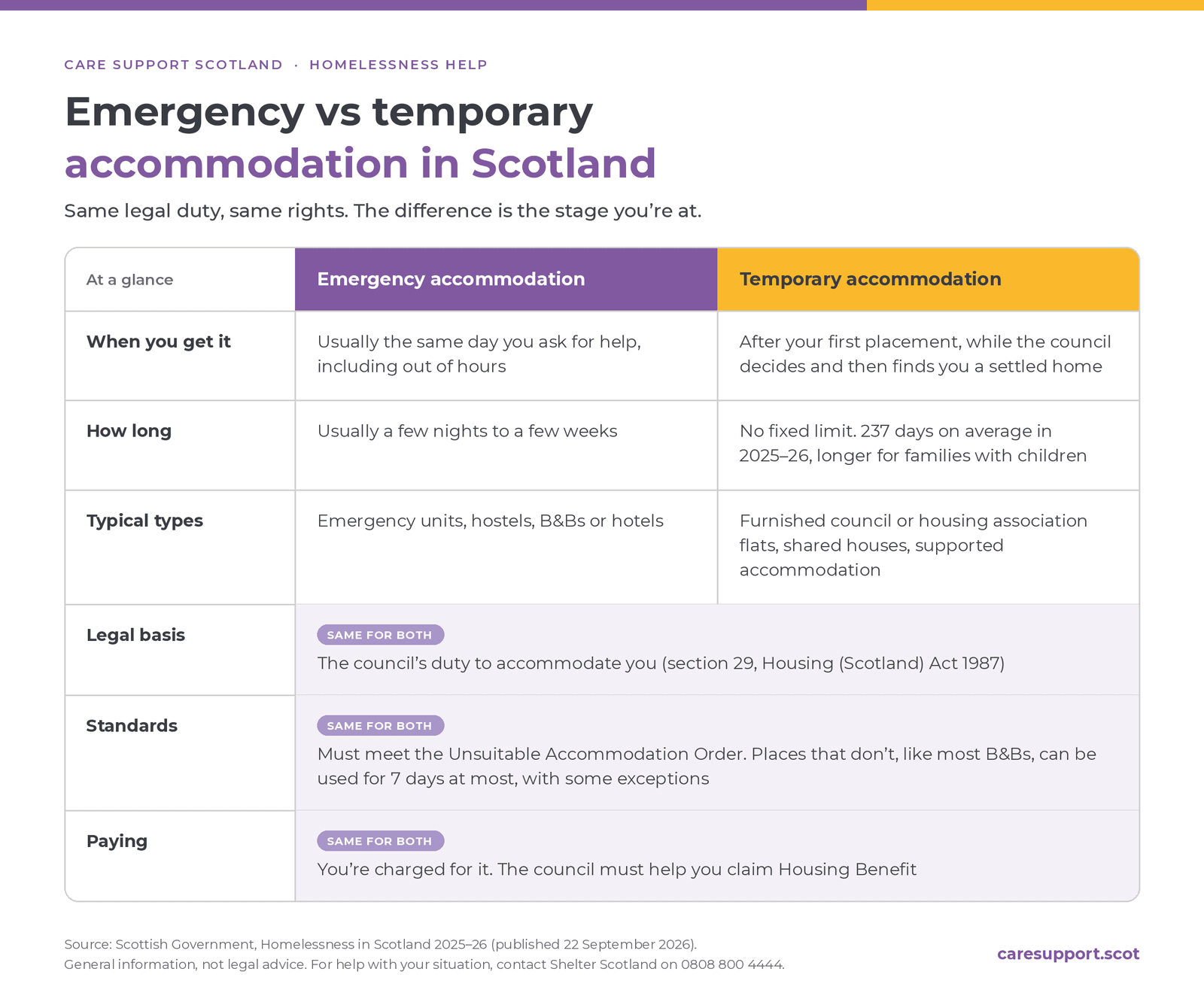
| At a glance | Emergency accommodation | Temporary accommodation |
|---|---|---|
| When you get it | Usually the same day you ask for help, including out of hours | After your first placement, while the council decides and then finds you a settled home |
| How long | Usually a few nights to a few weeks | No fixed limit. 237 days on average in 2025-26, longer for families with children |
| Typical types | Emergency units, hostels, B&Bs or hotels | Furnished council or housing association flats, shared houses, supported accommodation |
| Legal basis | Same for both The council’s duty to accommodate you (section 29, Housing (Scotland) Act 1987) | |
| Standards | Same for both Must meet the Unsuitable Accommodation Order. Places that don’t, like most B&Bs, can be used for 7 days at most, with some exceptions | |
| Paying | Same for both You’re charged for it. The council must help you claim Housing Benefit | |
What happens next: from your first night to a settled home
Every situation is different, but most people follow a path something like this.
- Day 1: you ask for help. You contact the council’s homelessness team. If you have nowhere safe to stay, it finds you somewhere that day.
- By day 7: out of unsuitable accommodation. If you were placed in a B&B or somewhere similar, you should be moved somewhere suitable.
- The council’s decision. The council looks into your situation and tells you in writing whether it owes you a settled home. If you disagree, you can ask for a review within 21 days.
- Temporary accommodation, with support. You live in temporary accommodation while you wait for an offer. This is often the longest stage.
- A settled home. The council offers you a permanent tenancy, usually with the council or a housing association.
If you get in touch out of hours, you’ll usually be given somewhere for the night. Then the council will ask you to complete a full assessment on the next working day.
This is a typical journey, not a guarantee. If anything isn’t clear, ask your homelessness officer what happens next for you.
Your rights while you’re in emergency or temporary accommodation
Wherever you’re placed, it should be safe, wind and watertight, and suitable for you and anyone who lives with you. Scotland’s standards also say you should be able to get in at any time, day or night, and that it should be in the council area where you asked for help.
Don’t turn an offer down.
If a place doesn’t feel right, accept it first, then challenge it in writing. If you refuse, the council may not have to offer you anything else. Shelter Scotland has template letters you can use.
You’ll be charged for your accommodation.
Most people can get Housing Benefit to help with the cost, even if you’re on Universal Credit, and the council must help you claim. Ask what is covered, so there are no surprises.
You can be asked to leave.
This usually comes with notice. If it happens, speak to your homelessness officer straight away.
If the council won’t give you anywhere to stay, don’t give up.
In 2025-26, there were 21,800 times when someone wasn’t offered temporary accommodation. If it happens to you, call Shelter Scotland on 0808 800 4444 or contact Citizens Advice Scotland the same day.
Note: This is general information, not legal advice. For advice on your own situation, speak to Shelter Scotland or Citizens Advice Scotland.
If you’ve read advice for England
A lot of homelessness advice online is written for England. If that’s what you’ve been reading, three things work differently here.
1. There’s no priority need test.
In Scotland, everyone who is homeless is entitled to help, not only families or people classed as vulnerable.
2. Local connection won’t stop you getting help.
A Scottish council can’t refer you to another Scottish council because you haven’t lived in its area.
3. Intentionality works differently.
Even if the council decides you made yourself homeless, it must still give you temporary accommodation for a reasonable time, plus advice and support.
How Care Support Scotland can help
We run both kinds of accommodation across Midlothian, as part of our homelessness support:
- Emergency accommodation at Jarnac Court in Dalkeith and Pentland House in Penicuik
- Temporary accommodation in Midlothian at Parkhead Lodge, SAS Dalkeith and the Polton Centre
- Supported accommodation at Eastfield House and Klibreck House, for adults with complex needs
- Accommodation for families through our Families Project
A roof is only part of it. Our staff help with benefits and budgeting, tenancy skills and wellbeing, and they help you plan your move into a settled home.
Places are arranged through your council’s homelessness team, so the first step is always to contact them. If you have questions about our services, or you’re supporting someone who’s staying with us, we’re happy to talk.
Need help now?
If you, or someone you care about, has nowhere safe to stay, contact your council’s homelessness team today. If you have questions about our accommodation services, our team is here to help.
Contact us for help today.
FAQs
Does the council have to house me tonight?
Yes. If the council has reason to believe you may be homeless, it must offer you somewhere to stay the same day. That includes evenings and weekends, through its out of hours number.
How long can I stay in emergency accommodation?
Usually a few nights to a few weeks. If you’re placed somewhere that doesn’t meet Scotland’s standards, such as a B&B or hotel, the limit is normally 7 days, though there are some exceptions.
Can I refuse temporary accommodation?
You can, but it’s safer to accept and then challenge the offer in writing if it isn’t suitable. If you refuse, the council may not have to make you another offer.
Do I have to pay for temporary accommodation?
Usually, yes. Most people can get Housing Benefit to help with the cost, even if they’re on Universal Credit, and the council must help you make the claim.
Do I need a local connection to get help?
No. Since November 2022, councils in Scotland can’t refer you to another Scottish council because you don’t have a local connection. Ask for help wherever you are.